

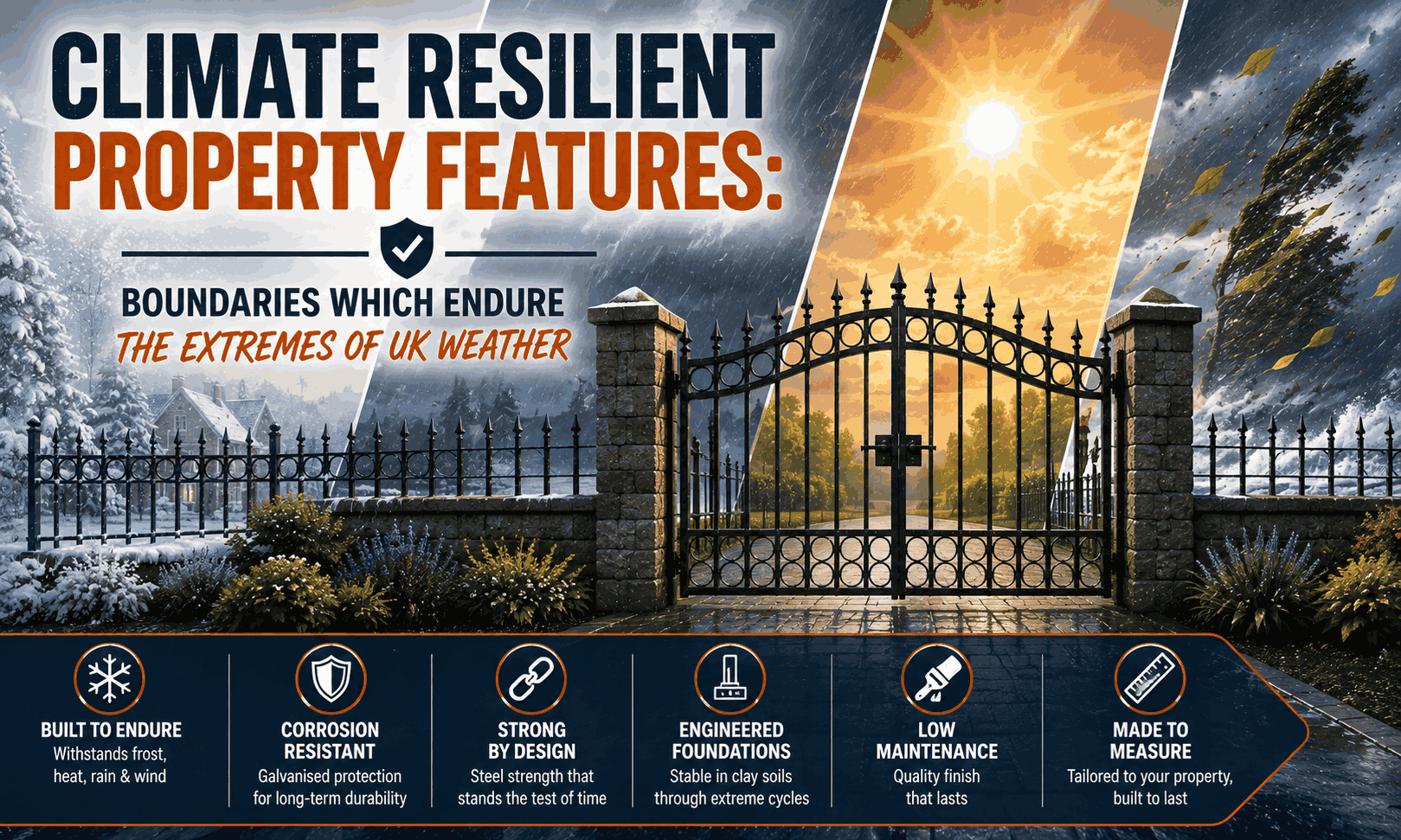
The weather in Britain is unpredictable – to say the least! However, we can’t complain this year that we haven’t had a good summer. And the summer of this year so far has broken records held for over a century – 37.7° in Norfolk in June, record breaking tropical nights in both Wales and England at once, three heatwaves in the span of several weeks. And then the winter of 2025 into the early part of this year brought temperatures to as low as -4° C with frost cycles punishing anything rooted in the soil. These aren't exceptional cases that precede normal British weather. They are the new normal – and the boundary products around properties in the UK must take this into account.
The issue property owners have to deal with is how the British weather will stress the gates, railings and fencing through these extremes. The question also arises as to which materials and approaches will deal with these extremes without progressively deteriorating, making costly repairs inevitable. And here at Wrought Iron Gates, we’ve put together the below article that might just clear things up on that front.
The Challenge That UK Weather Poses for Boundary Materials
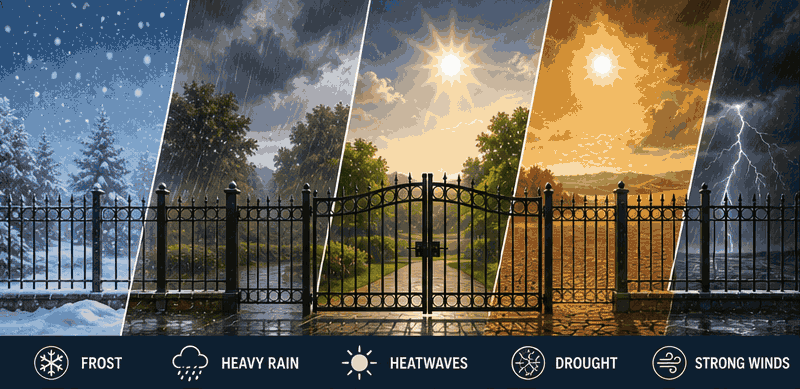
UK weather is a particularly stressful testing environment for the gates, railings and fencing materials. The challenge isn't in the extreme temperatures and frosts but in the cyclical changes between them that gradually wear things down.
Think of what the gates, railings and fencing faced throughout 2026. January saw freezing temperatures that caused ground movement because of dramatic contraction of clay soils. Then February saw a milder thaw and the rapid rehydration of the ground. Warmth in spring was quickly followed by record heat in May, which dried everything out. June's heat reached 37.7° C, causing thermal stress in metal gates and continued drought shrunken clay soils. Finally, July brought yet another heatwave and then the potential of autumn rain also must be taken into our thought process.
Steel and Wrought Iron Style Construction
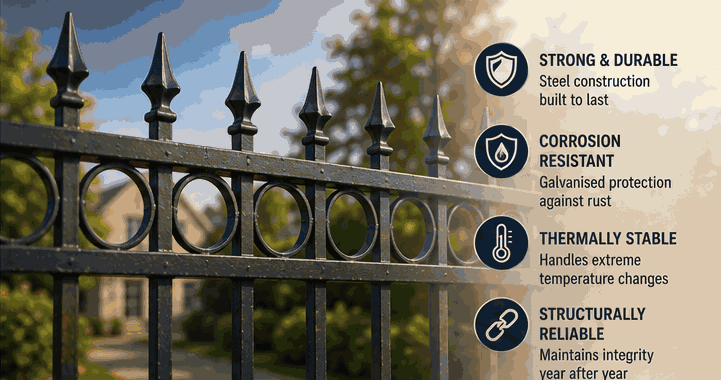
Wrought iron style steel construction outperforms all other materials for boundaries when it comes to coping with climate cycles. The reasons for it are rooted in material properties rather than marketing preferences.
Steel does not absorb moisture. It cannot swell, warp, or suffer internal moisture stresses that deform organic materials. When the temperatures increase or drop drastically, steel behaves predictably, moving through thermal expansion and contraction – predictable, consistent and manageable through proper installation design. In contrast to organic materials, these movements are fully reversible. Steel that expanded due to the heatwave of June reverted to exactly the original position as the temperatures normalised.
The galvanised coating that protects steel in our Abbey, Balmoral, Saxon, Warwick and Henley collections provides corrosion protection that works both as mechanical barrier and sacrificial protection at the same time. The zinc coating of the steel binds metallurgically, meaning the distinction between the two types of coating is important in terms of dealing with temperature cycling – this coating won't crack, lift or disband in the way surface-applied coatings on other metals do.
The structural integrity of steel doesn't suffer from climate exposure when the material is properly specified. Ten years of freeze and thaw cycling, prolonged drought and heat waves leave properly manufactured steel gates and railings functioning exactly like they did ten years ago. This is not true of timber that suffers deterioration. Composites start raising questions about the remaining life expectancy after ten years.
Foundation and Ground Movement Resilience
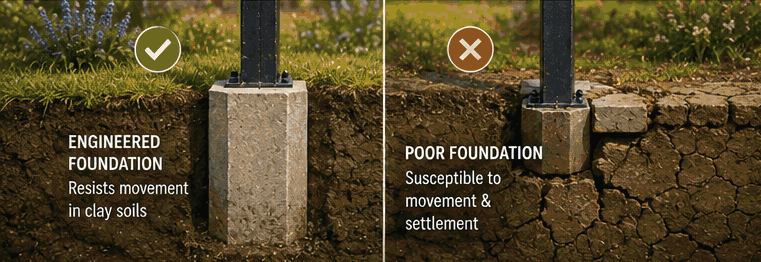
The climate resilience of boundaries extends beyond the surface and below ground.
The clay soils that dominate southern and central England – places that experience the largest climatic variations in UK – show increasingly dramatic patterns of movement as the UK weather changes. The clay shrinkage caused by the drought in 2026 was greater than ever recorded in previous dry summers. Post foundations that remained stable in previous years had begun to move as the ground had dropped significantly underneath them.
The weight of steel actually helps with it. The weight of the wrought iron style gates and railings requires proper engineering of the foundations from the very beginning. This engineering requirement, which can sometimes be viewed as complication, brings true climate resilience benefits. The foundations engineered to carry heavy loads resist better to clay movement than minimal foundations sufficient only for lighter materials.
Our made-to-measure service ensures that gate weights and sizes determine the proper foundation specification. This approach, developed in over 20 years of providing boundary solutions across the UK, builds climate resilience into the installations from the ground upwards, not leaving it an afterthought.
Open Structure and Climate Performance

The characteristic permeable design of wrought iron style gates and railings – the vertical bars, scrollwork and open fill patterns that define designs like Henley, Warwick and Royale Ascot collections – deliver practical climate resilience benefits along with aesthetic ones.
Open structure allows the wind to go through, not pushing against solid panels. In the times of increasingly frequent storms accompanying the climate change in UK, this feature reduces significantly the forces exerted on posts, foundations and fixings. The solid panel boundaries have to withstand the whole force of the storm wind. Open metalwork distributes the force through the structure, not concentrating it at mountings.
The same permeability affects the thermal behaviour. The solid boundary traps the heat against the surface. The open metalwork allows the circulation of the air and, thus, moderate the temperature extremes to which surface-applied coating is exposed. The black powder-coated solid panels can heat up to 55°C under the summer sun. The same open railing sections made from the same materials stay noticeably cooler just through the air circulation around bars.
Maintenance Resilience
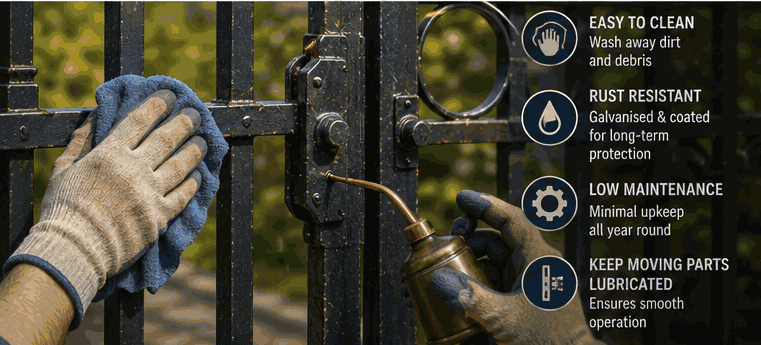
The climate resilient boundaries have to stay resilient without requiring constant intervention in the course of these extreme conditions.
Wrought iron style steel requires simple regular maintenance – the inspection of the coating, lubrication of moving parts and repair of any damage done before it progresses. These operations don't require any special skills and tools. What is even more important, they don't require any particular weather window like the maintenance of timber does.
The maintenance of timber requires specific temperature and humidity conditions. With the climate becoming increasingly unpredictable, these conditions become difficult to find regularly. The maintenance window that worked for timber boundaries ten years ago becomes frustrating now since suitable conditions are rare.
The Forward-Looking Investment
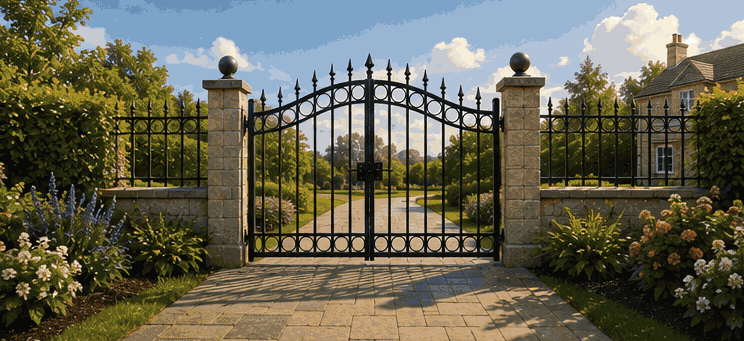
Choosing the climate resilient boundary materials isn't the pessimistic attitude towards the British weather – it's rational recognition that the conditions have changed and the selection has to anticipate that.
The boundaries installed today should still be performing in 2045. The climate these installations will be enduring until then will make 2026's extremes look relatively modest according to most projections. The material selection that provided adequate performance under the historical conditions can prove insufficient under the future ones. Cick here to view our range of gates, railings and fencing.