
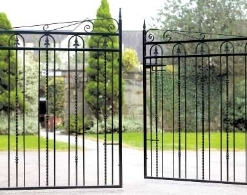



With April's dry spell coming, there couldn't be better timing for British gardens. There is sunshine, there is warmth, the lawns finally get mowed, borders get attended to...you go to close the front gate, and you cannot get the thing closed!
It was functioning just fine throughout the wettest months of the year. Now there is nothing obviously broken. But suddenly the gate refuses to operate correctly. This is especially annoying since things should be getting better with the soil being dry now.
And with these issues, and the root cause almost always has nothing to do with the gate itself. The reason is the clay composition of the British soil. Clay soil contracts as it loses moisture, and this contraction is rather pronounced – up to 20-30 mm in some cases. Since posts supporting the gate also contract, there will be some operational consequences, even without taking account of lateral movement.
Knowing this will help prevent some misconceptions about gate problems.
What Causes the Problem?
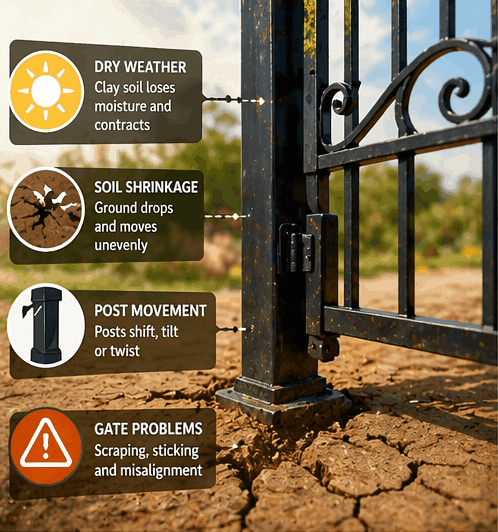
Ground movement happens predictably in certain kinds of soil, and understanding it is important both for troubleshooting and remediation purposes.
Soil Movement Patterns
While the contraction of the soil in dry weather is well-known, what might surprise many homeowners is just how much the soil can move and the direction of such movement. Posts do not fall straight down – there may be some leaning to the left or right side, forward or backward, or the gate post may even twist a little bit. Any kind of movement results in a different path the gate follows.
Areas particularly prone to this problem include Essex, Kent, the Midlands, and part of Yorkshire. Other areas may have sandier soils with far less dramatic movement.
Consequences of Clay Soil Shrinkage
Ground movement produces some clear patterns that one can easily spot when looking at the stuck gate problem.
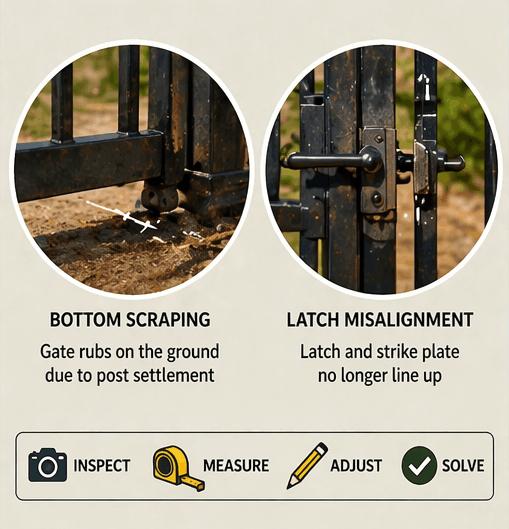
Bottom Scraping
A gate scraping along the ground as it opens/closes indicates a significant amount of settling. This is not a case of the gate sagging – the ground around posts settles instead. The scraping happens quickly in response to dry weather.
Checking this is as simple as taking a measurement from gate bottom to the ground along multiple points. Comparing them with photographs or data taken when the soil was more saturated gives an idea of how much movement there is.
Latch Misalignment
Latch misalignment is another clear sign of ground movement. Measure the distance from latch tongue to strike plate and see how much the posts settled. Vertical gaps suggest the posts contracted differently from one another, while horizontal ones mean posts shifted from side to side.
Misalignment like this usually doesn't vary a lot and tends to be consistent. A misaligned latch sticking out 15mm indicates a uniform pattern of ground movement.
Solutions to the Problem
There are several ways to deal with a sticky gate.
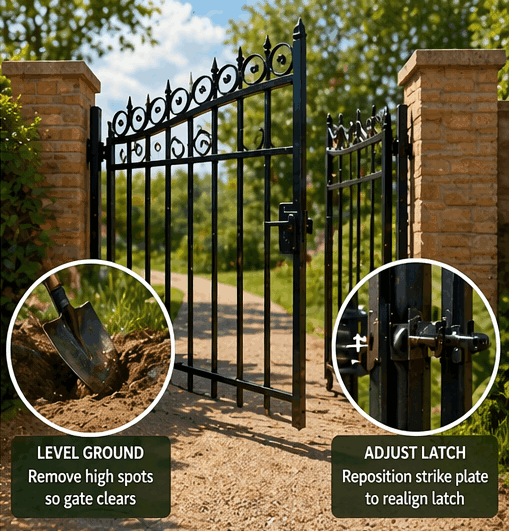
Ground Leveling
If the gate is scraping against the ground, lowering it to compensate for ground settling is the easiest solution. Excavate any troublesome spots the gate comes to contact with by digging up to 30-40mm below the surface.
While this does not address the root of the problem, it does make the gate operational again. It is important to mark the area excavated in case you need to restore it as soon as the soil settles again.
Latch Readjustment
In case of misaligned latches, the solution may lie in simple repositioning of strike plates. Measure the misalignment to see how much you need to move the strike plate.
Make sure to leave the original holes in place, since when the soil gets wet again and contracts back to its initial position, you can return the strike plate in its previous position.
Hinges
Many models of the Abbey, Balmoral, Manor, and Saxon gates offer adjustable hinges, meaning that you can perform some quick fixes on them.
Adjustable hinges allow minor compensation for the shifting gate posts, helping to keep the gate operating smoothly despite the posts being out of line.
Long-Term Solutions
Fixing the root cause of the issue ensures you won't have trouble in the future.
Drainage Control
Since soil movement in clay soils increases dramatically if water pools up and then dries, improving drainage will mitigate the effect significantly.
Make sure downspouts and gutters don't empty water near the gate. Installing water channels may help too.
Deep Post Installation
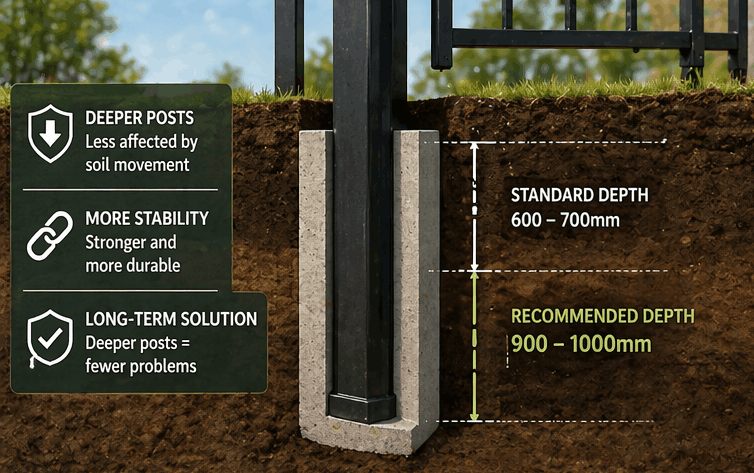
Shallow post installation means the gate is going to be more susceptible to changes caused by soil contracting. The standard depth is 600-700mm, while increasing to 900-1000mm decreases the effect significantly.
However, it involves replacing the posts and extensive excavation around the current ones. While the effect will last, it does involve considerable costs and labour.
Post Reinforcement
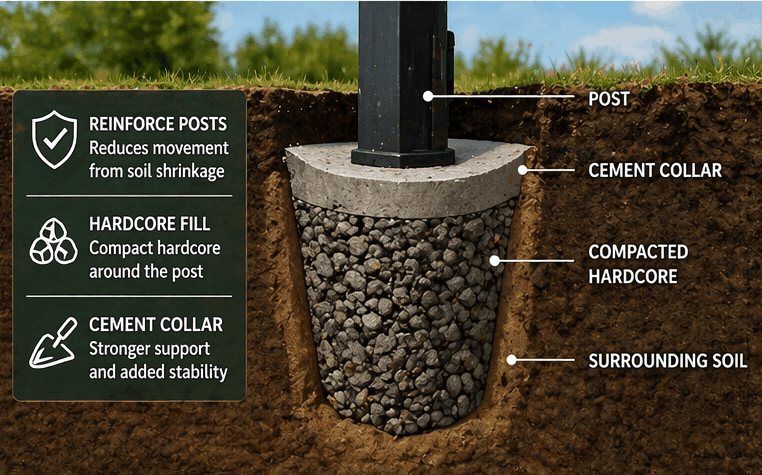
Another solution to the problem of posts moving in response to ground shrinkage is reinforcing them to minimise the impact.
First, dig around the posts and install properly compacted hardcore. Mixing this material with cement will create stronger collars around posts resistant to ground movement.
Conclusion
April's weather creates ground movement in clay soils, and the gate becoming difficult to open/close is a clear indicator of this process. Quick fixes to maintain the gate operability are available while long-term prevention is a possibility too.
Here at Wrought Iron Gates Direct, we have been manufacturing high-quality gates across the UK for over 20 years. The gates lasting the longest do not necessarily cost the most money – they are installed in suitable soil environments and undergo seasonal adjustment when required.